Watercolor Foggy Pine Forest Cliparts for Crafts
Evaluating Atmospheric Depth for Organic Brand Identity Projects
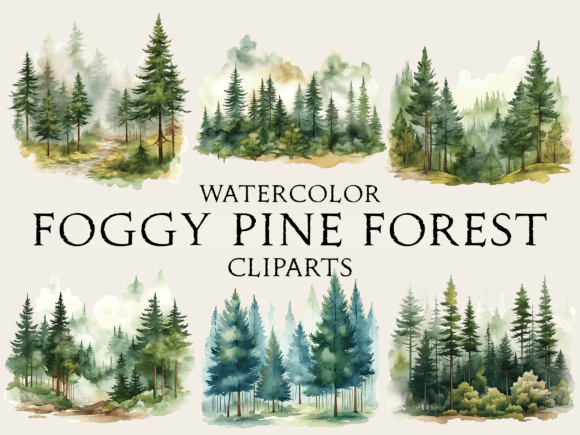
When assessing a new graphic design asset for a client rebrand, my first criterion is always emotional resonance over mere decoration. Recently, while developing a visual identity for an artisanal candle line focused on Pacific Northwest aesthetics, I evaluated the Watercolor Foggy Pine Forest Cliparts to determine if they could anchor the brand’s packaging and marketing visuals. The immediate impression was one of sophisticated tranquility. Unlike flat vector illustrations that can sometimes feel sterile or overly corporate, these watercolor elements possess a genuine organic texture. The interplay of muted greens, soft grays, and translucent washes creates a sense of depth and mist that digital filters often fail to replicate authentically.
For designers working with handmade business clients or nature-focused brands, this specific mood is invaluable. It communicates silence, purity, and craftsmanship without needing explicit typography to say so. In my test project, the clipart did not just serve as background filler; it established the entire color palette and tonal voice for the brand identity. However, professional evaluation requires looking beyond the initial aesthetic appeal to understand how this digital product performs under the rigorous demands of commercial production and cross-platform consistency.
Performance Across Packaging, Print-on-Demand, and Editorial Layouts
In practical application, the versatility of Watercolor Foggy Pine Forest Cliparts became apparent during the packaging design phase. We utilized individual pine boughs as corner accents on matte-finish candle boxes. Because the watercolor edges are soft and feathered rather than hard-lined, they blended seamlessly into the uncoated paper stock, avoiding the "sticker sheet" look that plagues lesser quality clipart. This softness is critical for small business branding where premium tactile experiences justify higher price points. For print-on-demand sellers creating tote bags or apparel, the transparency in the fog layers allows the fabric color to show through, making the t-shirt design feel integrated rather than stamped on.
For editorial design and blog visuals, these assets excel as hero graphics. When designing a website banner for our client, the horizontal spread of the forest scene provided ample negative space for headline copy. This is a common failure point in many nature-themed design bundles; they are often too busy to support text. These cliparts, however, respect visual hierarchy. The density of the paint varies intentionally, guiding the eye toward the center or edges depending on the composition. I also tested them in Canva template layouts for Instagram stories. The pre-separated elements allowed for rapid iteration, enabling us to create cohesive social media graphics in minutes without sacrificing the bespoke feel of custom illustration.
Crafters utilizing Cricut or Silhouette machines will find specific utility here as well. While watercolor is inherently raster-based, the high resolution supports excellent sublimation design work. For sticker design, the distinct separation between trees and fog makes cutting lines easier to manage compared to dense, solid-color forests. As a printable design resource for wall art, the atmospheric quality translates beautifully to home decor, appealing to the Etsy customer base seeking moody, cottage-core aesthetics.
Navigating Contrast Challenges and Visual Hierarchy Constraints
Despite their beauty, Watercolor Foggy Pine Forest Cliparts require careful handling to maintain professionalism. During my review, I noted that these assets struggle in low-contrast environments. Placing light gray fog elements against a white background resulted in a loss of detail that made the design look unfinished. This asset demands intentional background selection. It performs best against cream, charcoal, slate blue, or kraft paper tones. Designers must avoid using these on pure white digital interfaces unless a subtle drop shadow or underlying texture is added to ground the image.
Furthermore, scale is a significant factor. These are not icons. Attempting to shrink these detailed watercolor paintings down to 1-inch sizes for business cards or favicon use destroys the integrity of the brushwork. The fog becomes pixelated noise, and the pine needles lose definition. This creative design element is meant for medium-to-large applications. In logo design, they should only be used as supporting marks or lockups, never as the primary logomark itself, due to reproduction limitations at small scales. For minimalist corporate projects requiring razor-sharp lines and high-impact legibility, this asset may be too passive. It serves modern design best when the goal is evocative storytelling rather than aggressive sales conversion.
Readability is another checkpoint. When using these as backgrounds for marketing visuals, ensure sufficient contrast ratios for accessibility. White text over the darker pine areas works well, but text placed over the foggy sections requires a dark overlay or text box. Ignoring this leads to poor user experience and diminished visual trust. The emotional appeal of watercolor should enhance communication, not obscure it.
Technical Due Diligence: File Integrity and Licensing Verification
Before integrating Watercolor Foggy Pine Forest Cliparts into any commercial design workflow, a technical audit is non-negotiable. My review process included the following checks that every designer and creator should perform:
- Resolution Stress Test: Zoom to 100% and inspect edge quality. Ensure there is no artificial sharpening or JPEG artifacting around the transparent areas. For product mockup use, 300 DPI at print size is the absolute minimum standard.
- Transparency Inspection: Open PNG files in Photoshop or Procreate to verify true alpha channel transparency. Some marketplaces sell "transparent" cliparts that actually have white backgrounds masked out poorly. True transparency is essential for layering in web design and composite imagery.
- Monochrome Conversion: Convert the asset to grayscale. Does it still hold its form? If the image relies entirely on color contrast rather than value contrast, it will fail in single-color printing or embossing applications.
- Typography Pairing: Test against various typefaces. I found that serif fonts with high contrast (like Bodoni) created a stunning editorial tension against the soft watercolor. Conversely, delicate handwritten scripts sometimes competed with the brush textures. Bold sans-serifs provided the best balance for Etsy product listings.
- Licensing Audit: Never assume usage rights. Verify the commercial license specifically covers your intended use case. Some licenses permit physical end products but prohibit digital templates or NFT creation. Confirm whether attribution is required for creative marketplace sales or client deliverables.
- Format Versatility: Check if the bundle includes both PNG and SVG formats. While watercolor is raster-native, having an SVG container or vectorized outline version can be helpful for registration marks in screen printing or laser engraving alignment.
Final Verdict for Professional Application
Watercolor Foggy Pine Forest Cliparts represent a high-value asset for specific niches within the design assets ecosystem. They are not a universal solution, but for projects demanding organic warmth, atmospheric depth, and artisanal credibility, they outperform generic stock vectors significantly. The key to successful implementation lies in respecting the medium's limitations regarding contrast and scale. When applied with intentionality in brand identity, packaging, and seasonal campaigns, these cliparts elevate the perceived value of the final product. For the discerning designer or small business owner, this collection offers a reliable foundation for building visuals that feel both professionally polished and authentically human. Always validate technical specs against your specific output requirements, but creatively, this asset delivers the moody sophistication that current market trends favor.